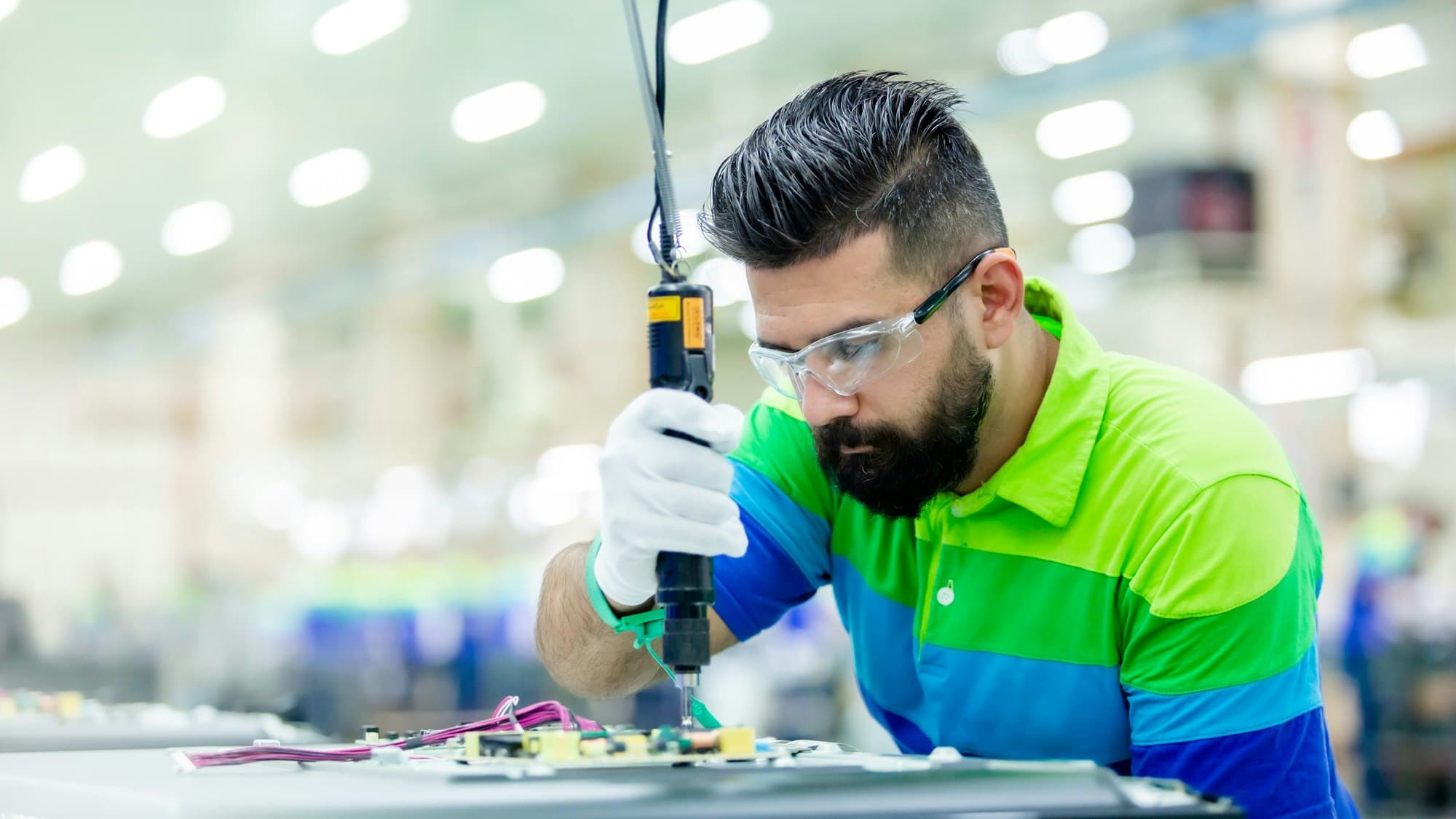
Manufacturing recruitment
Manufacturing hiring sits at the handover between R&D and volume production, where the wrong hire surfaces months later as yield problems and missed ship dates.
Electronics manufacturing is its own problem even where the job titles match general manufacturing. Volumes are lower and tolerances tighter than mass consumer production, and defence and aerospace work carries component traceability and provenance requirements a general background rarely covers.
The scarcest candidates are the ones who have taken a product through NPI or industrialisation rather than supported a line already in steady state. We screen for that, alongside DFM, process control, and the fluency in yield and cost that holds up at volume.
What the market pays
- Briefed max, median
- £50,000
- ONS actual, median
- £47,711
Middle 50%: £34,200 - £51,200
SOC 2125
Manufacturing Engineering briefed maximums, 2023-2026 data window. A briefed maximum is the top of the budget a client set for the role, not the salary transacted. Full Manufacturing Engineering breakdown
What this covers
- New Product Introduction (NPI) & industrialisation
- Process engineering
- Manufacturing / production engineering
- Design for Manufacture (DFM)
- Automation & line design
- Continuous improvement / Lean
Roles we place
What makes a strong Manufacturing candidate
A strong manufacturing candidate can describe specific yield or cost improvements they've driven, not just processes they've maintained: what the baseline was, what changed, and what the measurable outcome was. NPI experience, having actually taken a product from prototype through pilot build into stable volume production, is one of the clearest differentiators in this discipline, since it's a genuinely different skill from running an already-mature line. We also look for comfort working the shop floor directly rather than only from a desk, since the best manufacturing engineers tend to be the ones who go and look at the line when something goes wrong, rather than waiting for a report.
At manufacturing manager and production manager level, the bar shifts from personal technical contribution to running a function: owning a line's output, headcount and cost against a target, not just solving the technical problems on it personally. We screen against the actual scope of a brief, NPI versus steady-state, single-line versus multi-line responsibility, rather than the job title alone, since manufacturing manager and production manager are used inconsistently enough across employers that the title on a CV is a weak signal on its own.
Where the talent sits
Manufacturing engineering demand tracks the UK's electronics and precision-manufacturing base most heavily in the Midlands, the North West and the South East, with additional concentration wherever a client's own production facility sits. Manufacturing roles are also among the least remote-friendly on the Manufacturing & Operations team, since the job is inherently tied to physical presence on or near a production line.
Typical hiring timeline
Most briefs get a first candidate within days rather than weeks - see real timelines from past searches. Seniority, location and clearance status set the pace from there.
Live Manufacturing roles
Facilities & Maintenance Coordinator
Buckinghamshire · £28,000 – £32,000 per year
Production Operator
Hertfordshire · £27,000 – £30,000 per year
Test Technician
Hertfordshire · £30,000 – £35,000 per year
Contract Quality Engineer
Essex · £40 – £50 per hour
Manufacturing hiring: frequently asked questions
Hiring in Manufacturing?
Tell us what the role needs to do. We'll come back with questions about the work, and an honest read on what the brief will take.